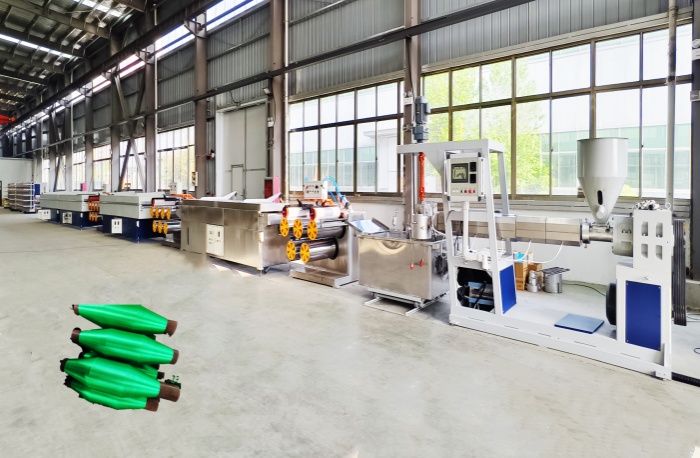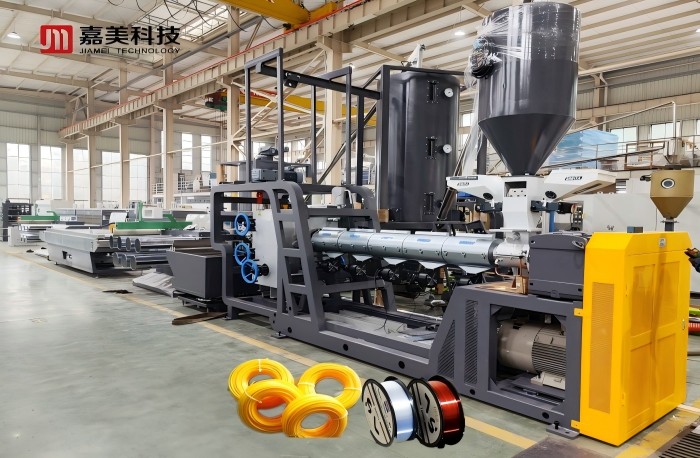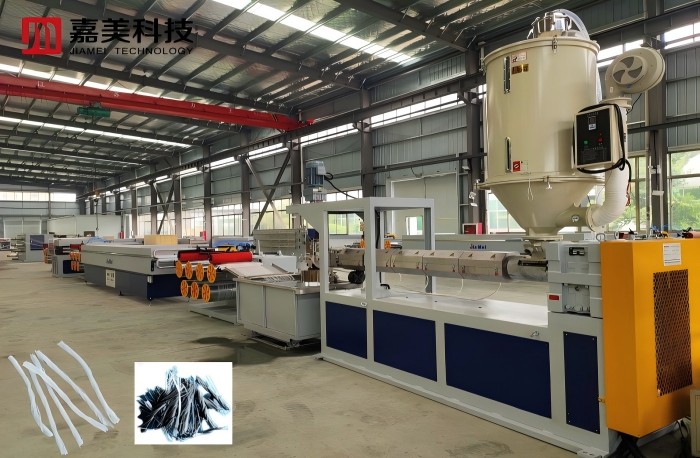
Continuous production is essential for a monofilament extrusion line, but filament breakage can interrupt production, reduce output, and affect product consistency.
Monofilament breakage can have different causes. The problem may originate from the raw material, extrusion process, spinneret, cooling and drawing conditions, heating system, or winding tension. Identifying the actual cause is important before making adjustments to the machine.
The condition of the polymer has a direct influence on stable monofilament production. PP, HDPE and PA may require different processing conditions according to their material properties.
For PA monofilament production, moisture control is particularly important because nylon is sensitive to moisture during processing. Contamination or unstable material feeding can also affect melt quality and cause irregular extrusion.
A consistent raw material feed helps the monofilament extruder machine maintain stable melt pressure and uniform filament formation.
The extrusion section must provide a stable and uniform polymer melt. Incorrect temperature settings, unstable melt pressure, or insufficient plasticization may result in uneven filament formation.
When the melt is not sufficiently uniform, weak points may appear in the filament. These weak points can become more obvious during the drawing process and eventually lead to breakage.
For this reason, extrusion temperature and output should be adjusted according to the PP, HDPE or PA raw material and the target filament specification.
The spinneret is responsible for forming the polymer melt into continuous filaments. Its hole diameter, condition, and cleanliness can influence filament uniformity.
Blocked or damaged holes may cause uneven filament diameter or unstable melt flow. A filament with a significant diameter variation may be more likely to break during drawing.
Regular inspection of the extrusion die and spinneret is therefore important for stable monofilament production.
Drawing gives monofilaments higher orientation and can improve their mechanical properties. However, excessive drawing tension or an unsuitable draw ratio can increase the risk of filament breakage.
The appropriate drawing conditions depend on the raw material, initial filament diameter, target diameter, heating conditions and final application.
A stable drawing system should maintain synchronized roller speeds and controlled filament tension throughout the production process.
Heating is normally used to make the filament suitable for drawing and heat setting. If the heating conditions are not properly matched with the material and production speed, filament performance may become unstable.
Insufficient heating can make drawing more difficult, while excessive heating may negatively affect filament stability or dimensional control.
Therefore, the heating temperature, roller speed and draw ratio should be considered together rather than adjusted independently.
The winding section is the final stage of the monofilament extrusion line. Excessive or unstable winding tension can place additional stress on the filament.
Proper winding speed and tension help maintain a stable package and reduce the possibility of filament breakage during winding.
The winding configuration should also be selected according to the final product, such as fishing line, brush filament, rope filament, net filament or industrial monofilament.
When filament breakage occurs repeatedly, it is better to check the production process step by step rather than immediately changing one machine parameter.
First, check the raw material and feeding condition. Then inspect the extrusion temperature and melt stability, followed by the spinneret condition, drawing tension, heating temperature and winding tension.
This step-by-step approach makes it easier to identify whether the problem comes from material, extrusion, drawing, or winding.
There is rarely a single reason for monofilament breakage. Stable production depends on the coordination of the entire monofilament extrusion machine, from material feeding and melt extrusion to drawing and winding.
For PP, HDPE and PA monofilament production, machine parameters should be adjusted according to the material, filament diameter, production capacity, line speed, and final application.
A properly configured monofilament extrusion line can provide more stable extrusion, drawing and winding, helping manufacturers reduce production interruptions and maintain consistent filament quality.
For a customized monofilament extrusion solution, provide the target material, filament diameter, production capacity and end application when selecting the machine configuration.



Copyright © Jiamei Machinery Technology Co., Ltd. All Rights Reserved | Sitemap