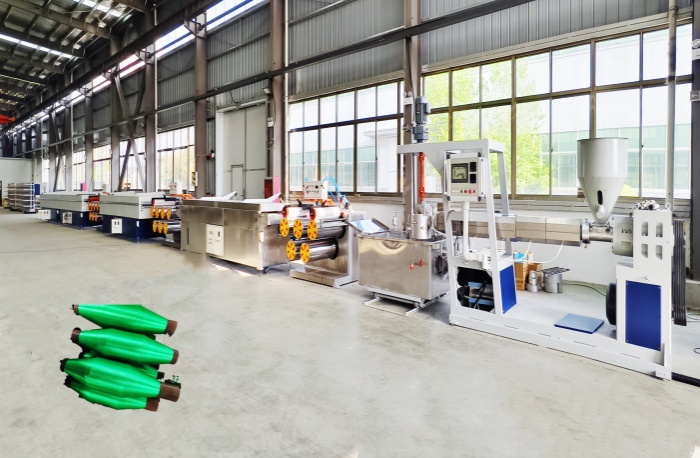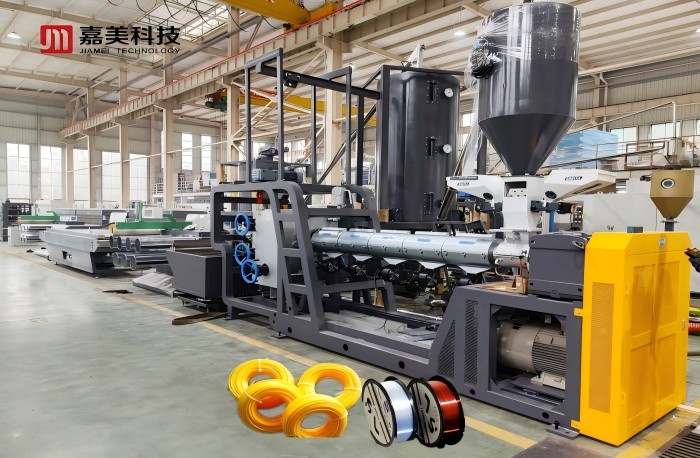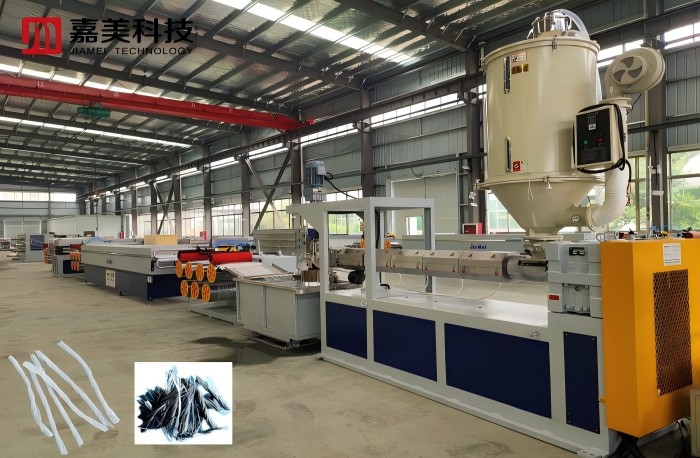
HDPE cable filler rods are round plastic filaments used in electric cable manufacturing. They fill the gaps between cable cores, helping maintain a consistent cable shape and supporting the cable structure during manufacturing.
High-density polyethylene (HDPE) is commonly selected for this application because of its low moisture absorption, electrical resistance and mechanical properties.
Depending on cable construction requirements, filler rods are manufactured in different diameters and specifications.
Jiamei's HDPE cable filler rod extrusion machine is designed to produce round HDPE monofilaments with diameters ranging from approximately 1.6 mm to 4 mm.
An HDPE cable filler rod extrusion line converts plastic raw materials into continuous round rods through extrusion, cooling, drawing and winding.
The main production stages include:
HDPE resin is fed into the extruder, where the screw conveys, melts and plasticizes the material under controlled heating conditions.
The molten polymer is then pushed through a specially designed extrusion die to form continuous round filaments.
After leaving the extrusion die, the molten HDPE filament enters a cooling system.
Proper cooling helps stabilize the filament shape and maintain consistent diameter throughout production.
The filament passes through drawing rollers to achieve the required mechanical properties and dimensional consistency.
Drawing conditions, including roller speed and temperature, should be adjusted according to the raw material and target rod specifications.
After drawing and cooling, the finished cable filler rods are collected by the winding system.
Stable winding tension helps prevent tangling, deformation and inconsistent package quality.
The quality of cable filler rods directly affects their performance in downstream cable manufacturing.
Consistent diameter is essential for maintaining uniform filling performance.
For cable filler rod production, the extrusion die, cooling conditions and drawing system should work together to maintain the required dimensions.
Cable filler rods need sufficient mechanical strength to withstand handling and cable manufacturing processes.
Raw material selection and drawing conditions both influence the final product properties.
HDPE offers useful heat-resisting and electrical-resisting properties for cable-related applications.
The final product should be tested against the requirements of the intended cable construction.
Continuous production requires coordinated operation of the extruder, cooling system, drawing rollers and winding equipment.
A stable process helps reduce diameter variation, filament breakage and production interruptions.
Different cable filler rod manufacturers have different output requirements. Machine selection should consider the required rod diameter, production capacity and factory conditions.
Jiamei offers several machine configurations for HDPE round cable filler rod production:
| Machine Model | Screw Diameter | Reference Capacity |
|---|---|---|
| JM65 | 65 mm | 50 kg/h |
| JM70 | 70 mm | 75 kg/h |
| JM80 | 80 mm | 100 kg/h |
| JM90 | 90 mm | 125 kg/h |
The actual production output depends on the raw material, product diameter and operating conditions.
Buyers should also consider the following factors:
Target cable filler rod diameter and dimensional tolerance.
Required production capacity and working hours.
Extruder configuration and heating system.
Cooling and drawing equipment.
Winding requirements and finished package size.
Electrical supply and factory installation space.
Jiamei Machinery has more than 40 years of experience in extrusion machinery manufacturing, providing customized equipment solutions for different plastic monofilament applications.
The HDPE cable filler rod extrusion machine offers several features:
Specialized design for HDPE round filament and rod production.
PLC control system with touchscreen operation.
Compact equipment layout.
Configurations available for different production capacities.
Installation, commissioning and operator training support.
From raw material processing to finished rod winding, Jiamei can provide equipment configurations according to customers' production requirements.
If you are planning to manufacture HDPE cable filler rods or expand your cable material production capacity, contact Jiamei to discuss your required diameter, output and machine configuration.
Explore the equipment: HDPE Monofilament Round Cable Filler Rod Extruder Machine
HDPE (High-Density Polyethylene) is commonly used for cable filler rod production because of its low moisture absorption, electrical resistance and mechanical properties.
Jiamei's cable filler rod machine is designed for round rods with diameters of approximately 1.6–4 mm. The actual range depends on the machine configuration and production requirements.
Jiamei offers JM65, JM70, JM80 and JM90 models, with reference capacities ranging from 50 kg/h to 125 kg/h.
The production process generally includes raw material feeding, extrusion, cooling, drawing and winding. Each stage must be adjusted according to the required rod diameter and mechanical properties.
Yes. Machine configuration can be selected according to the target rod diameter, production capacity, raw material and winding requirements. Customers should provide their product specifications before equipment selection.



Copyright © Jiamei Machinery Technology Co., Ltd. All Rights Reserved | Sitemap